
The competition for the cover image
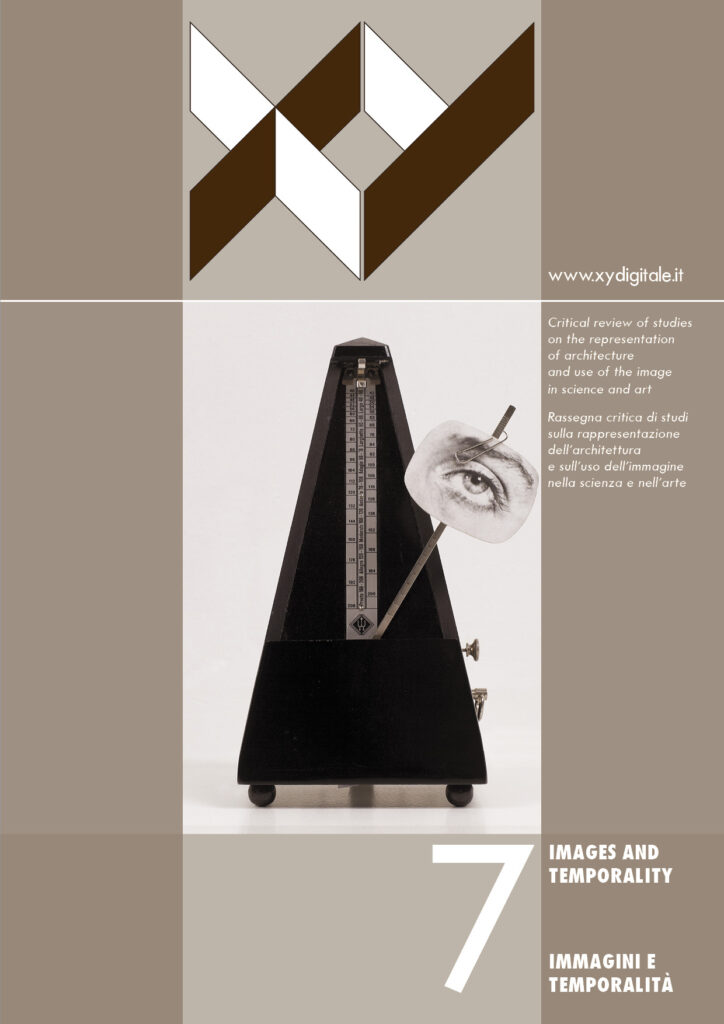
Afterword. The journey of the sign
The visual aestheticization of the architectural project and its relationship with the duration of the image
In a period in which architecture privileges its communication through the image instead to other traditional systems such as elevations, plants or perspectives, in a global process that authors such as Joan Fontcuberta have defined within the second digital revolution like the ‘fury of the images’: the photographs circulate through the network at a vertigo […]
The time of photography in the representation of architecture and landscape
Pierre Sorlin, in his book Les fils de Nadar, argues that in the years following the invention of photography, the debate focused on the identification of the differences between the latter (analogue image) and painting (synthetic image). These differences concern, among other things, the execution time: the synthetic image is related to the time ‘internal’ […]
Time marks papers, papers mark time
“Maps cease to be understood primary as inert records of morphological landscapes or passive reflections of the word of objects, but are regarded as refracted images contributing to dialogue in a socially constructed world”1 . The historical cartography is part with full rights of the cultural heritage, which is so much precious but also very […]
Saving images. Memory and oblivion of knowledge in the digital age
Some of the contemporary phenomena that concern memory and the transmission of knowledge such as the digitization of archives, the rapid obsolescence of digital technologies, the power of data cloud service providers who store information, question the ways of knowledge transmission that have consolidated over the millennia. We live in an age of excess of […]
Reproduce to preserve. From the disappearance of the original to the multiplied memory
In a far–seeing article published in Domus in September 1994, Franco Purini identified the ‘disappearance of the original’ as one of the intellectual questions posed by “the development of computer science applied to the representation of architecture”. The technical capability to reproduce works of art (and items of cultural heritage in general), thus freezing their […]
‘Missing’ images: the frescoes by Andrea Mantegna in Padua
The Church of the Eremitani in Padua is a place of undeniable cultural and historical value, and a popular tourist destination, its principal attraction being the famous cycle of frescoes dedicated to the stories of Saint James and Saint Christopher in the Ovetari Chapel (1448–1457). Work on the frescoes was begun in 1448 by a […]
Shape, graphic synthesis and contemporaneity? The case of the rock engravings of Monte Bego
“The image durability is therefore a guarantee of human self–awareness”. From these words, taken from the text of the call for paper of this issue of XY, we must start to read today the incredible rock engravings of Mount Bego, which constitute a heritage handed down intact thanks to the support that houses them and […]
The embossed technique on metal plate
The embossed technique on a metal plate, unlike the print engraving, is used to perform artistic works mainly on copper, brass, silver and gold so as to obtain an ornamental pattern in relief. The toreutica, which is part of its own artistic sphere, focuses on works of greater size and weight with respect to a […]