
The competition for the cover image
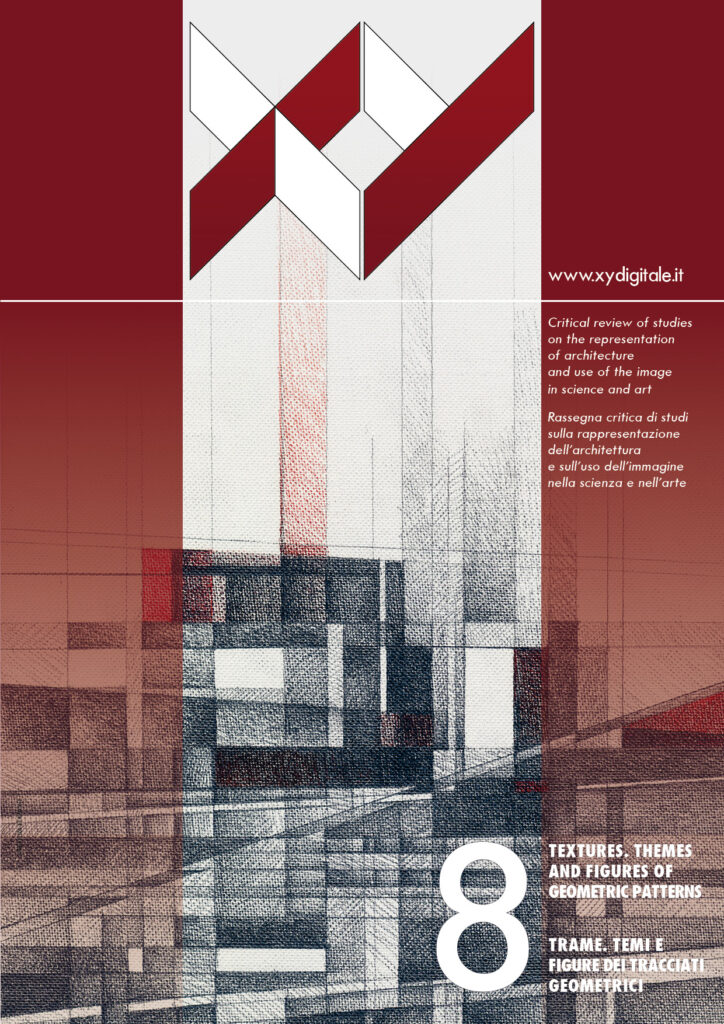
Textures and patterns of space. Images of the temporary and of the human and spatial infinity
In the terrestrial landscape each path defines the image of a possible direction and along its course the points that intersect it and interrupt it define the distance. Thus, the trace marked on the earth draws and orders the terrestrial landscape first, creating a dimensional and formal relationship between the void and the horizon, and […]
The paths for the drawing of Rome
Archaeological studies and antiquarian visions by an architect who was director of the Flavian Amphitheater underline landscapes and memories of Mediterranean, measuring them by the geo–astronomical patterns hidden in the maps of Rome. The checkpoints of that foundation memorize a topographical code practiced by triangulations which links the natural paths by registering them as historical […]
From ornament to the city. The teaching of Eugène Grasset within the urban design of Le Corbusier
Le Corbusier presents for the first time the Plan de la Ville de 3 millions d’habitants in 1922 at the Salon d’Automne. At that time the Swiss architect had already completed an important part of his artistic training. His training started at the École d’Art municipal in his native town La Chaux–de–Fonds, and continued in […]
Vertical fabric and other mythologies: some examples of contemporary textures
The word fabric can be traced back to various interpretations relating to the different aspects that the term suggests. Weaving is one of the first occupations of man and is attributable to the natural need to cover and shelter. The textile activity involves an ordered union of a multitude of elements which, once associated, establish […]
Santa Maria dell’Ammiraglio: method and interpretation
In Norman Sicilian churches, the synthetic–abstract ability to manage elementary geometries by Arab workers, meets with the Byzantine ascetic interlocution, firmly nourished by the incontrovertible dogmas of Mount Athos. The only ones evoke the divine with a blocked architecture, with large surfaces and a simple and rigorous stereometry; the others, with images shown on walls, […]
Textures and geometric patterns applied to industrial works. A manuscript of artistic paleography in the Cassinian codes
The introduction to the 1884 manuscript, entitled La Paleografia artistica nei codici cassinesi applicata ai lavori industriali esemplata da un monaco di Montecassino, and the annexed 60 graphic plates provided an opportunity for reflection on the plot concept. Through a historiographic and iconographic geometric pattern reading, which distinguish the patterns of these arts applied to […]
Geometric patterns in the decorations of Vietri ceramics
The use in architecture of decorative elements made of ceramic material, for making floors or wall tilling, has ancient origins and has been increasingly widespread over the centuries. These coatings have constituted singular occasions for artistic expression: in them, in fact, the ornament plays with the shapes of the single ceramic tile, intertwining with the […]
Fashion wefts and geometries of design
The combination of fashion and transformation frames a current reality where the subjects and their dressing practices are the objects of processes of a constantly mutating identity building. At the centre of the debate on fashion design there is always a human body which interacts and coexists with the technologies that inhabit it: they, at […]
‘Matrix’ images. Tapestries as precursors of digital images
The reproduction of images can involve processes of translation into codes that, through particular technological devices, can then allow to replicate it. Among the possible codes that can have this function, one in particular seems to be particularly adequate for the transmission of information and therefore also of images: the matrix, certainly understood in its […]