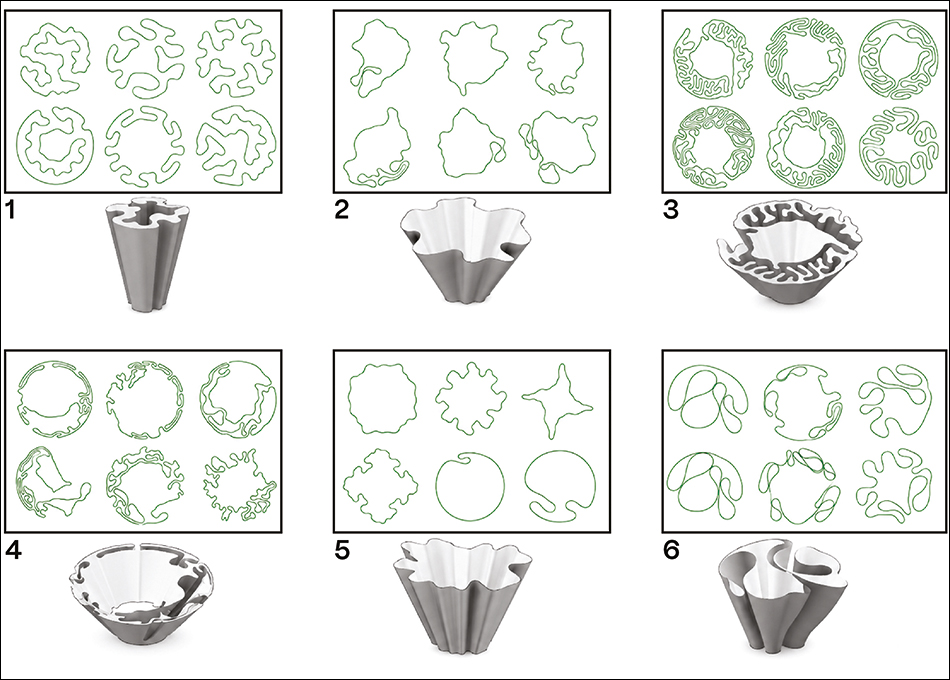


This contribution investigates the text-to-form process as a form of artificial exaptation applied to computational design. It treats natural language not merely as a descriptive medium, but as an operational device capable of activating generative processes by establishing relationships between words, perceptual qualities, geometric parameters, and configurations suitable for additive manufacturing.
Starting from the same generative framework, the essay compares two approaches to translating text into form. The first is based on a semantic-parametric dictionary, in which keywords and numerical ranges make the language–parameter–form sequence explicit and verifiable. The second integrates a language model into the algorithm, expanding the interpretive space while introducing new challenges related to transparency, reproducibility, and the validation of generated geometries.
The comparison between the two systems does not seek to establish technical superiority, but rather to clarify two distinct regimes of intersemiotic mediation: one more controlled and traceable, the other more open-ended and inferential. Within this tension, additive manufacturing becomes a criterion for validating the translation process, making it possible to distinguish a form that is merely semantically coherent from a configuration that is actually manufacturable.
The proposed innovation therefore lies not in the automation of form, but in the refunctionalisation of language, parameters, and computational models within new design relationships.