
Iconographic Exposition
A Lens between Nature and Death. Cemeteries: The Staging of New Hybrid Landscapes, Places where Symbiosis Generates Life
Lichens are an association of species: a plant organism originating from the symbiosis between a fungus and an alga, capable of transforming an apparently lifeless place into a space suitable for life. The organism resulting from this symbiosis is a new individual, suspended between the kingdoms of Fungi and Plantae. ‘Marginality’ is not only a […]
Peri-urban Observatories: The Case Study of La Cantueña in the Metropolitan Area of Madrid
The term ‘periphery’ and the expression ‘peri-urban territory’ are currently generating conceptual confusion, both in collective imagination and academic debate. This is reflected in the diverse methods used to investigate and represent areas that defy categorisation and cannot be defined univocally. Such areas are often described as marginal, unresolved, residual, transitional, and also as zones […]
Alphabet of ‘Spaces-between’. Similarities and Changes of Places In-between
The urban analysis of highly historicised fabrics is not always immediately intelligible, especially when one seeks a spatial dimension so rarefied1 and lacking in clear definition that it becomes difficult to categorise – like that of ‘in-between’ places. The space in between – between things – is the place of connections, where the focus of […]
The Human-Space Relationship in Barrio Mugica (Villa 31) of Buenos Aires: The Necessity of Human Habitation
This study concerns the relationship between man and space in Barrio Padre Carlos Mugica, formerly Villa 31 of Buenos Aires, which can be traced back to the human need to inhabit the world. The relationship between man and space is the root of all Villas in Buenos Aires and Argentina. It is a relationship based […]
Experiences of Visuality in Urban Regeneration Processes between Memory, Participation, and Imagination
This article aims to explore the role of the image as a tool for critical reflection and active community participation in urban regeneration practices. To this end, three design initiatives – 10 Porte sul Futuro, Luoghi Dismessi, and Prossima Apertura, implemented in the metropolitan area of Rome and its immediate hinterland – have been selected. […]
Commercial Ruins. Representative Analysis of New Neglected Marginalities for their Adaptive Reuse
The evolution of the contemporary city, dominated by the neoliberal consumerist logics, has led in the last century to a centripetal urbanism marked by commercial construction. These works, scattered across suburban areas and inherently indifferent to aesthetics, were conceived solely to serve market logic. Yet, after only a few decades, they lost their function and […]
Between the Visible and the Invisible: the Perspective of the Margin for Narratives of Suspended Places
“Art does not reproduce the visible; rather, it makes visible” (Klee 1959: 76): the increasing interest in dismissed and marginal places, which are becoming ever more prevalent in contemporary urban, industrial, and rural contexts, necessitates a profound reflection on the languages and representational devices that accompany and anticipate their transformation processes (Maniglio 2010). This article […]
To Depict the Landscape at the Edges, Utilizing Unconventional Maps and Graphic Experimentation Techniques
The European Landscape Convention (Florence, 2000) has extended the focus from landscapes of exceptional value to degraded territories, implicitly recognising the crucial role that all places play for the quality of life of populations, in urban and rural areas. In this cultural and social perspective, the landscapes of everyday life, the abandoned landscapes, and finally […]
Editorial. Epochal Signs
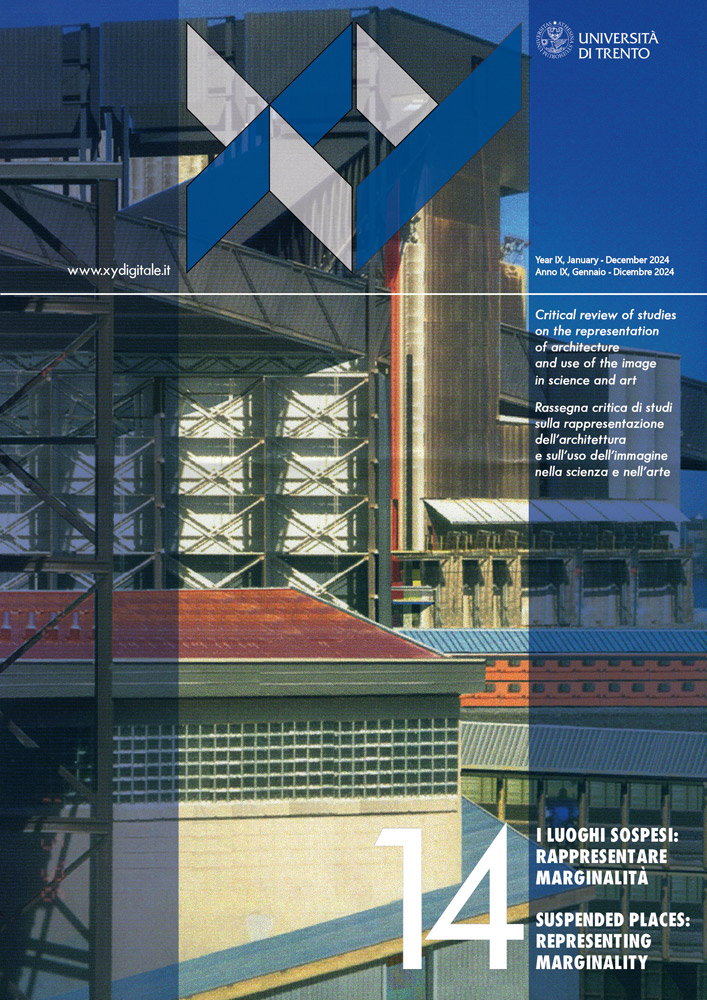
In the editorial, Giovanna A. Massari introduces issue 14 of “XY”, devoted to the ‘suspended places’ and the representation of marginality. The text revisits a research direction already explored by the historical series of “XY dimensioni del disegno” in the 1990s, when the ‘suburban issue’ was considered not only as an urban problem, but as […]